




How We Built HMIS: A Real Hospital Management Software Project
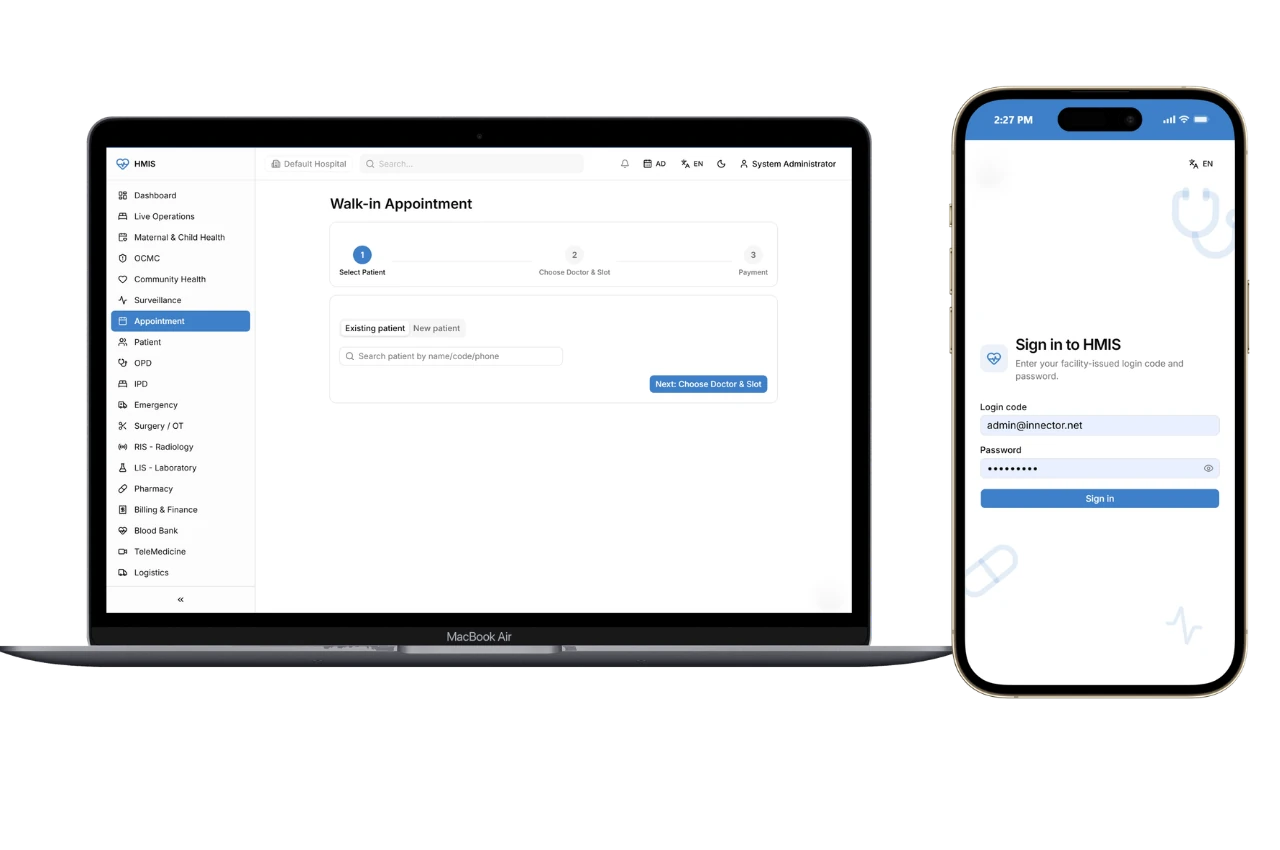
It's easy for any company to say "we can build complex software." It's more convincing to simply show one. HMIS (Hospital Management Information System) is a real system Innector built, with more than 29 connected modules that run a hospital's daily work from one screen: patient care, diagnostics, pharmacy, inventory, billing, insurance, accounting, and even national health reporting.
What HMIS Actually Does
A hospital doesn't run on just one task. It needs to manage patients, doctors, appointments, medicine, test results, and money, often all at the same time, without mistakes. HMIS brings all of that into one connected system instead of several separate tools that don't talk to each other.
The Five Areas HMIS Covers
HMIS is organized into five main areas, each covering a different part of running a hospital:
- Command Centre: a live dashboard, appointments, reports, and a full activity log
- Patient Care: patient records, outpatient visits (OPD), inpatient admissions (IPD), Emergency, Surgery, and TeleMedicine
- Diagnostics & Supply: the Laboratory, Radiology, Pharmacy, Blood Bank, and general inventory (Logistics)
- Public & Community Health: maternal and child health, community health programs, immunization records, disease surveillance, and birth and death registration
- Business & Administration: billing, insurance claims, full accounting, staff records, and system settings
Following a Patient Through the System
A good way to understand HMIS is to follow a single patient through it:
- Register: the patient's details are entered once, including Nepal's address system and their Health ID or National ID.
- OPD (Outpatient): for a regular visit, the patient joins a queue by doctor and department, with a live "in progress" or "completed" status.
- IPD (Inpatient): if the patient needs to be admitted, HMIS tracks their bed, consultant, and reason for admission, right through to discharge.
- Emergency: in the emergency room, patients are triaged (marked by urgency using a colour code), assigned a bed, and tracked until an outcome is recorded.
Every one of these steps uses the same patient record. Nobody has to type the same information twice.
Diagnostics: From Sample to Result
When a doctor orders a lab test or a scan, HMIS tracks it from start to finish. The Laboratory module handles test catalogs, result entry, and flags critical findings that need urgent attention. The Radiology module works the same way for X-rays and other imaging. Both modules track turnaround time, in plain terms, how long it actually takes to get a result back to the patient.
Pharmacy: From Shelf to Sale
The Pharmacy module tracks medicine stock, with low-stock alerts so nothing runs out unexpectedly, and also works as a point-of-sale system at the counter. It supports the payment methods people in Nepal actually use: cash, eSewa, Khalti, FonePay, and card, and it automatically handles medicines that are exempt from VAT under Nepal's tax rules.
Money Matters Too: Billing, Insurance, and Real Accounting
Every action in HMIS, a consultation, a test, a medicine sold, automatically creates a billing line. Nothing has to be typed into a separate system.
HMIS also manages full insurance claims, including Nepal's Social Health Insurance and HIB (Health Insurance Board) submissions, with clear queues for anything that needs attention, like an expired deadline or a rejected claim.
Behind all of this sits a real double-entry accounting ledger, the same kind of proper bookkeeping system a qualified accountant would expect, not just a simple list of payments. It includes a full chart of accounts, journal entries, and financial reports like a trial balance, profit & loss statement, and balance sheet.
Built Specifically for Nepal
HMIS isn't a generic template with a new logo on it. It's built around how healthcare actually works in Nepal: the provincial address system, pricing in Nepali Rupees, VAT-exempt medicines, Nepal's Social Health Insurance process, and DHIS2, the system health authorities use to collect national health data. Reports can be exported and fed directly into that national system, instead of being copied in by hand.
Why This Project Matters
Anyone can claim to "build complex software." Building a system this connected, where a mistake in one part (like billing or a lab result) can affect patient care, takes real experience and a real process. This is exactly the kind of proof our guide on evaluating an outsourcing company tells you to look for: not just words, but a real, working result.
What This Means If You're Evaluating Us
If your own project is smaller than a hospital system, that's completely fine, most are. The point isn't that every project needs to be this complex. It's that a company capable of handling this level of detail, more than 29 connected modules, all working correctly together, can almost certainly handle yours.
Conclusion
Real projects are the best proof of what a company can actually do. See our full guide on choosing the right partner for your project, or get in touch to talk about what you're trying to build.